
In clinics and classrooms across the country, sustainability can feel like an overwhelming challenge. A challenge measured in operating room drapes, single-use devices, and supply chains far larger than any one person. At the University of Iowa Department of Ophthalmology, however, a different approach has taken hold: start small, be intentional, and build something that lasts.

That philosophy is at the heart of the department’s contact lens recycling program, launched by third year medical student Simran Sarin with early support from the American Academy of Ophthalmology (AAO) Young Ophthalmologist Green Grant.
An idea whose time had come
Sarin’s involvement began in fall 2024, when an email circulated among medical students interested in the intersection of sustainability and ophthalmology. “I’ve always cared deeply about sustainability,” she says, “but there wasn’t much happening locally in ophthalmology. When this opportunity came up, I jumped at it.”
Through the AAO’s Young Ophthalmologist Green Grant, Sarin joined a small national cohort of institutions piloting contact lens recycling programs. Each institution would collect contact lens waste and when they had a critical mass, they would ship the waste to TerraCycle, a recycling company that works with businesses, government entities, and individuals across the globe to keep trash out of landfills.
“I’ve always cared deeply about sustainability—but there wasn’t much happening locally in ophthalmology. When this opportunity came up, I jumped at it.” The concept was simple but powerful: collect used and expired contact lenses and their associated packaging, items too small and specialized for standard recycling streams, and send them to TerraCycle, a company equipped to process this kind of material.
For Iowa, the timing was right. Department leaders like Dr. Christine Sint and Maliq Pruitt, who both worked in Contact Lens, had long been interested in sustainability initiatives but lacked the dedicated time and infrastructure to launch one. “They were excited to get on board,” Sarin recalls. “They had been wanting to do something like this, they just needed someone to spearhead the project.”
Why contact lenses?
In a field that generates significant medical waste, focusing on contact lenses might seem modest. That’s exactly the point.
“There are some sustainability battles that are huge,” Sarin explains, pointing to surgical draping and operating room workflows that require institutional-level change. “Contact lenses are different. They’re small, they’re used every day, and they’re almost impossible to recycle through normal channels.”
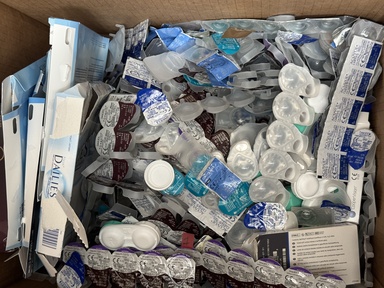
Blister packs, lenses themselves, and even tiny eye drop caps are often rejected by municipal recycling programs or lost during processing. TerraCycle’s program is designed specifically to capture this “small but mighty” waste stream; items that feel inconsequential individually but add up quickly in a busy academic department.
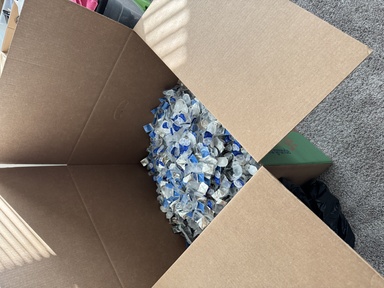
Over the past year, those tiny items have totaled nearly 70 pounds of collected material, a figure that surprised even the program’s organizers.
“This is exactly the kind of waste that gets lost—small, seemingly inconsequential, but adding up to a lot.”
From pilot to program
The AAO grant provided critical seed funding, covering the cost of TerraCycle collection boxes and enabling Iowa to participate in the national pilot. But the grant was intentionally short-term. When it ended, Sarin faced a familiar sustainability challenge: how to keep momentum going.
Using data gathered during the pilot phase, she applied for additional support through the Graduate Student Program Green Initiatives Fund at the University of Iowa Carver College of Medicine. The results spoke for themselves.
The boxes themselves have an upfront cost,” Sarin explains. “That covers TerraCycle’s processing and recycling, and it isn’t cheap. But when we showed how much waste we’d already diverted and how engaged the department was, it made a compelling case.”
The funding was approved, securing multiple large TerraCycle boxes that will sustain the program for at least the coming year and potentially beyond.
The work behind the scenes
Running the program requires more than good intentions. Once collection bins in the contact lens department are full, Sarin coordinates pickup, often fitting the work around clinical responsibilities and coursework. At her home, materials are sorted carefully: cardboard packaging is recycled locally, liquids are removed from blister packs, and remaining items are prepared according to TerraCycle’s specifications.
Shipments are intentionally infrequent. TerraCycle requires a minimum of 10 pounds per shipment, a threshold that helps ensure the environmental benefit of recycling isn’t offset by transportation emissions.
Recognizing that long-term success depends on continuity, Sarin is actively recruiting younger medical students to help with processing and coordination. “I don’t want this to end when I leave,” she says. “The goal is for this to be a sustainable program in every sense of the word.”
Turning waste into something more
For Sarin, part of the program’s appeal is knowing exactly where the waste goes.
“Your contact lenses might become a city bench. Knowing that makes the effort feel worth it.” TerraCycle repurposes processed plastics into durable materials used for products like park benches and outdoor furniture.
“Your contact lenses might become a city bench. Knowing that makes the effort feel worth it.” TerraCycle repurposes processed plastics into durable materials used for products like park benches and outdoor furniture.
“I use daily contact lenses, and the amount of waste from personal eye care alone is astonishing,” she says. “It can feel discouraging, but knowing that this material is being turned into something useful—that your contact lenses might become a city bench—that makes a difference.”
A call to the Iowa ophthalmology community
The contact lens recycling program is one step in a much larger conversation about sustainability in ophthalmology—one that is gaining momentum nationally. Sarin believes Iowa is well positioned to be part of that leadership.
“This field is paying attention to sustainability in a way it hasn’t before,” she says. “I think Iowa should be part of pushing those boundaries.”
For alumni inspired by the program, there’s an immediate takeaway: it’s replicable. TerraCycle’s system is accessible to private practices and academic centers alike, and Sarin is eager to help colleagues workshop funding strategies or implementation plans.
Sometimes meaningful change doesn’t start with sweeping reform. Sometimes it starts with something as small as a contact lens—and a community willing to see its potential.
Click here to get your own contact recycling kit from TerraCycle!