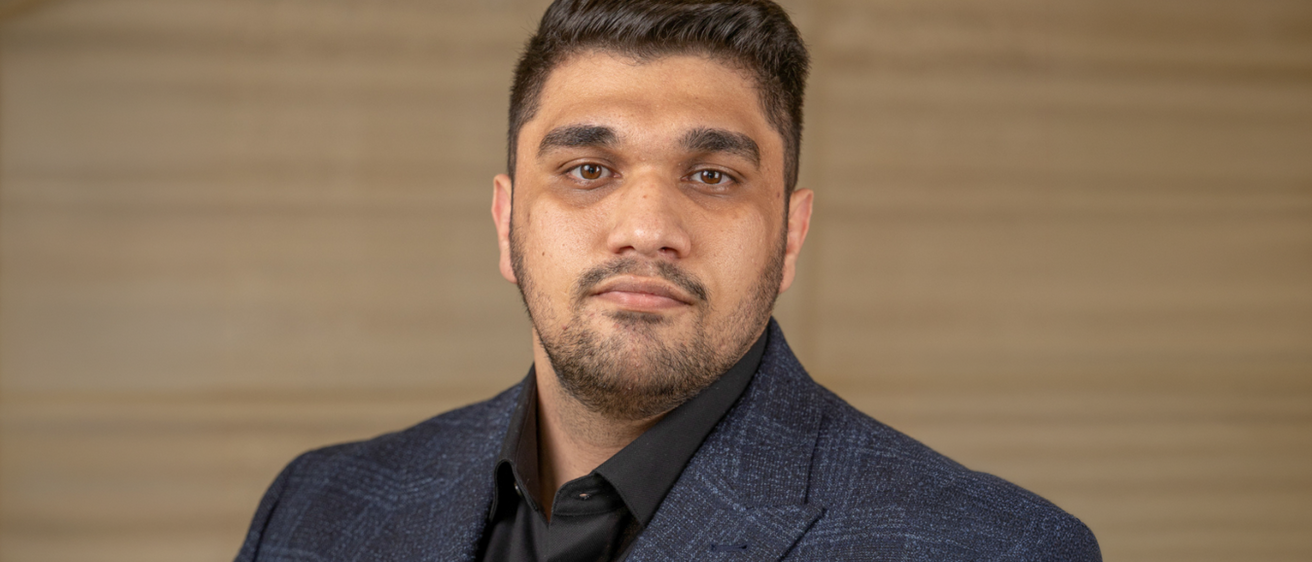
University of Iowa graduate student Alireza Salimi has been named a 2026–2027 Iowa Innovation Leadership Fellow, recognizing his work to develop new regenerative approaches for glaucoma and other vision-threatening diseases.
Salimi is a PhD candidate in Molecular Medicine in the University of Iowa Carver College of Medicine and conducts his research in the Department of Ophthalmology and Visual Sciences in the laboratory of Markus H. Kuehn, PhD, professor of ophthalmology and visual sciences and principal investigator of the Glaucoma Cell Biology Laboratory.
His research focuses on one of the central mechanisms underlying primary open-angle glaucoma: dysfunction of the trabecular meshwork, the tissue responsible for regulating the drainage of aqueous humor from the eye. Impaired outflow through the trabecular meshwork can lead to elevated intraocular pressure and ultimately contribute to irreversible damage to the optic nerve.
In the Kuehn Lab, Salimi is investigating regenerative strategies designed not simply to lower intraocular pressure, but to restore trabecular meshwork function. One aspect of his work explores using magnetic fields to help direct stem cells to the trabecular meshwork, with the goal of restoring aqueous humor outflow and normalizing intraocular pressure.
Salimi is also studying the interactions between induced pluripotent stem cell-derived trabecular meshwork cells and primary human trabecular meshwork cells. His work examining transcriptomic changes following co-culture of these cells was presented at the 2025 Midwest Eye Research Symposium and at the 2026 Association for Research in Vision and Ophthalmology (ARVO) Annual Meeting.
His broader research background includes stem cell therapy, RNA nanotechnology, bioinformatics, and molecular biology. At Iowa, he is applying that experience to the development of regenerative and nanotechnology-enabled therapies for ocular disease.
The Iowa Innovation Leadership Fellowship, administered through the University of Iowa Office of Innovation, will provide Salimi an opportunity to develop another dimension of his translational research: learning how promising discoveries can move from the laboratory through intellectual property protection, regulatory pathways, commercialization, and ultimately clinical application.
For Salimi, that translational focus is closely connected to his work in ophthalmology. His long-term goal is to help transform advances in regenerative medicine into therapies that can preserve vision and improve outcomes for patients with glaucoma and other eye diseases.
“Alireza Salimi's passion for innovation is rooted in a desire to ensure that scientific discoveries extend beyond the laboratory to improve patients' lives,” the UI Office of Innovation noted in announcing his fellowship.
The fellowship will allow Salimi to build on his scientific training while developing the skills needed to bridge research, therapeutic development, and patient care.