
In science fiction, retinal scans are often associated with futuristic surveillance, high-security facilities, and dystopian governments. From Hollywood films to popular video games, the technology is frequently portrayed as a powerful tool for tracking and identifying individuals.
But in modern medicine, retinal imaging serves a very different purpose: helping clinicians detect disease, preserve vision, and improve patient care.
A new paper published in Ophthalmology, coauthored by University of Iowa ophthalmologist and researcher Michael D. Abramoff, MD, PhD, explores the striking disconnect between how retinal imaging is depicted in popular fiction and how it is actually used in healthcare.
Abramoff and coauthors Caroline Kay Allen, MLIS, and Pearse A. Keane, MD, examined references to retinal imaging across books, magazines, movies, television programs, and games dating back to 1940.
Their findings reveal a consistent pattern. Of the 209 fictional works identified, 194 portrayed retinal imaging as a tool for identification or authentication, and 198 presented it in an adversarial context. Only four referenced its medical applications.
The researchers traced these portrayals from early science fiction literature to familiar films and video games, including Star Trek II: The Wrath of Khan, Demolition Man, and Half-Life.
Fiction Versus Medical Reality
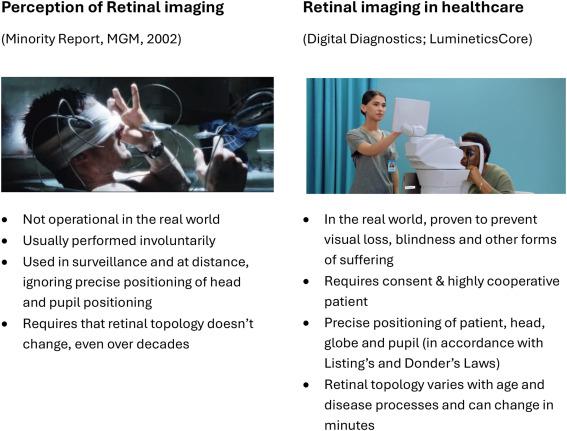
While fictional retinal scanners often identify individuals instantaneously or from a distance, medical retinal imaging requires specialized equipment and careful positioning of the patient's eye.
The technology captures detailed images of the retina, the light-sensitive tissue at the back of the eye, allowing clinicians to identify changes associated with conditions such as diabetic retinopathy.
Retinal imaging also plays an increasingly important role in artificial intelligence. AI-based systems can analyze retinal photographs to detect signs of disease, helping expand access to screening and support earlier intervention.
The authors emphasize that retinal imaging is fundamentally different from iris recognition, a technology already used for biometric identification. Although retinal identification is theoretically possible, the paper notes that it has no known current real-world application for human identification.
Why Public Perception Matters
The researchers suggest that fictional portrayals may contribute to misconceptions about retinal imaging, particularly regarding privacy and surveillance.
These concerns could have implications beyond public opinion. Retinal images are valuable for medical research and the development of AI systems, and the authors caution that misunderstandings about their use could create unnecessary barriers to sharing appropriately deidentified images.
The paper draws an intriguing historical parallel to optography, a 19th-century theory suggesting that the retina could preserve the last image seen before death. Although the technique proved impractical for human criminal investigations, its popularity in fiction helped inspire real-world investigative attempts.
The authors suggest that retinal imaging may represent another example of fictional portrayals shaping expectations about a technology's capabilities.
While the study documents how retinal imaging appears in fiction rather than directly measuring its influence on public attitudes, it raises important questions about the relationship between popular culture, scientific understanding, and healthcare innovation.
For researchers and clinicians working to advance AI-assisted eye care, the message is clear: Helping the public understand what retinal imaging actually does may be just as important as addressing misconceptions about what it might do.
Publication: Abramoff, M. D., Allen, C. K., and Keane, P. A. (2026). “Misperceptions of Retinal Imaging in Popular Fiction.” Ophthalmology. Read the paper.