Years before Andrew Pouw, MD, began mentoring University of Iowa medical students through their first research projects; he was the student looking for someone to show him the way.
As a medical student, Pouw joined the research group of Alfredo Sadun, MD, PhD, at the Doheny Eye Institute. What he found there went well beyond an opportunity to work on a project.
The group became a collaborative community where research fellows, residents and more experienced members helped younger students learn both the mechanics of research and the culture of ophthalmology.
“It became this wonderfully collaborative family of people all interested in research,” Pouw said, with members showing one another “this is what ophthalmology is like. This is the research process, and here’s how we’re going to guide you and help you through it.”
Pouw particularly remembers attending his first Association for Research in Vision and Ophthalmology (ARVO) annual meeting. It was “a heck of a lot of fun and very validating,” he recalled. “‘Oh my gosh, this is what I think I want to do.’”
Today, Pouw is an assistant professor in the University of Iowa Department of Ophthalmology and Visual Sciences. And the medical student research group he has built at Iowa increasingly resembles the community that helped launch his own career—but this time, Pouw is the mentor.
Learning from one another
The Pouw Research Group brings together medical students at different stages of training to work on projects spanning glaucoma, perimetry, iris lesions and melanoma, medical education and clinical informatics.
But Pouw's goal isn't simply to produce research.
He wants students to see that research is “broad, and multifaceted,” while learning skills ranging from study design and statistics to manuscript writing. One of the group's guiding principles is simple: “Older students mentor the younger students.”
Grant Leach experienced that model almost immediately after joining the group early in his first year at the UI Carver College of Medicine.
Leach had limited research experience and wasn't sure how much he could contribute. Pouw gave him a project that could potentially lead to ARVO and connected him with fourth-year medical student Lilly Gonzalez, who had worked on a similar project.
Leach remembers Gonzalez showing him the entire process, from designing a study to crafting a manuscript.
“No question I had was too minor, and no task I needed help with was too frivolous—she always had my back,” Leach said.
The experience gave him confidence as a researcher and a desire to do the same for others.
“This type of culture is infectious in the best possible way,” Leach said. “Dr. Pouw has cultivated an environment where I genuinely want to help others within the group, and I really feel that they would do the exact same for me.”
Ronak Singh has already watched that cycle begin to come full circle.
Now a third-year medical student, Singh joined the group as the only member of his medical school class. He started by helping older students with a large chart review comparing glaucoma drainage devices.
“That served as the perfect apprenticeship,” Singh said.
As Singh gained experience, he began leading projects himself. He is now working on a study evaluating virtual-reality headsets for visual field testing that will continue after his remaining time at Iowa.
That means preparing the next group of students to take over.
“Setting up the protocol, documentation, and workflow so I can seamlessly hand the reins over to the newer students has been one of the most rewarding parts of the experience,” Singh said, “and it is how the culture keeps moving forward.”
Taking the lead
That progression, from helping with an established project to leading one, is deliberate.
“I set them up with an individual project that I’m trying to have them headline,” Pouw said. Students can participate in study design and data collection through manuscript preparation and presentation.
Leach got that opportunity during a summer research project with Pouw. Pouw established the project's goal and provided examples to help guide the study design, but left Leach to determine how to design the study and process the data.
“He still provided plenty of additional guidance and was always available to help me troubleshoot, but he gave me enough space to really make me feel as though I was working independently,” Leach said.
That approach is possible in part because Pouw casts a wide net when it comes to research. His students have studied glaucoma surgical outcomes, barriers to care, virtual-reality visual field testing, iris melanoma risk, medical education, and clinical informatics.
One of his research principles captures that openness: “No idea too ‘small’ as long as it hasn’t been written before.”
For students, those projects can lead to manuscripts and publications. But Pouw also has another destination in mind.
A full-circle trip to ARVO
Pouw explicitly lists ARVO as a goal for the research group.
In 2026, both Singh and Leach attended.
Singh presented research comparing rebound tonometers with Goldmann Applanation Tonometry. But what stayed with him most was watching Pouw interact with former mentors, collaborators and trainees.
“It was remarkable to see how small the field feels and how invested people are not just in the science, but in each other’s growth and careers,” Singh said. The experience, he added, “solidified my goal of pursuing a career in academic ophthalmology.”
For Leach, attending such a large conference as a first-year medical student was intimidating. Pouw walked the meeting with the students, introduced Leach to colleagues, and used poster presentations as opportunities to explain how he interprets research.
“ARVO was a very unique opportunity that allowed me to meet many like-minded people, form closer bonds with the members of our research group, and to build confidence in a large conference setting,” Leach said.
There is a fitting symmetry to those experiences.
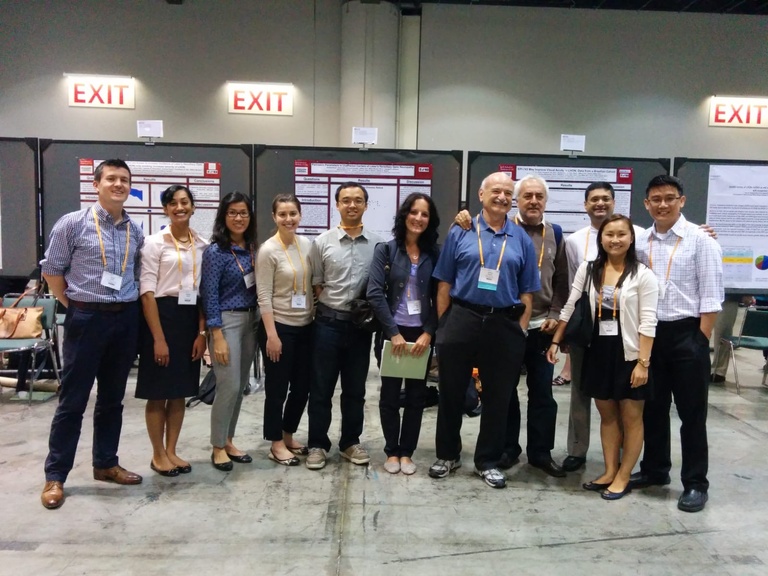
Near the beginning of a presentation Pouw gives about his research group is an old photograph of him as a medical student with the research community that helped introduce him to academic ophthalmology and research.
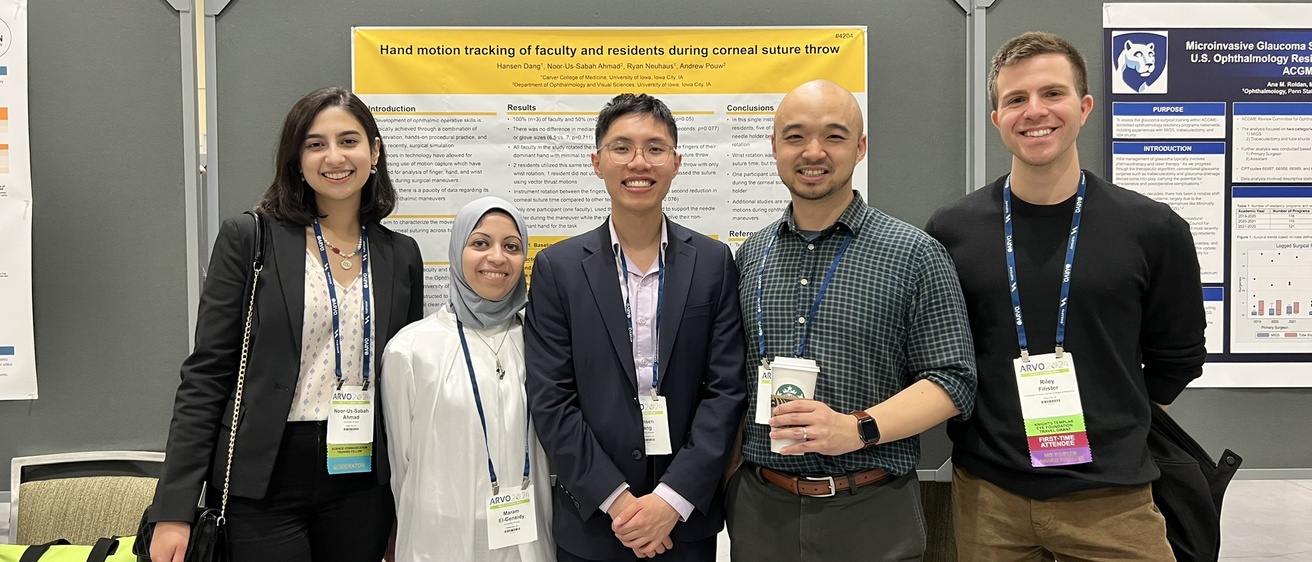
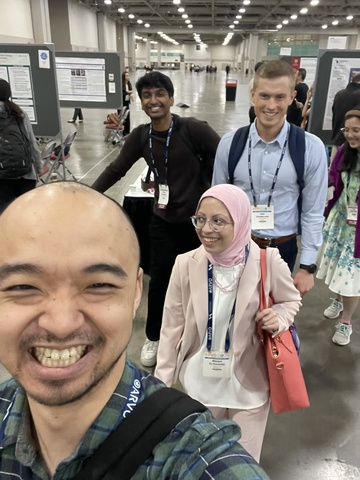
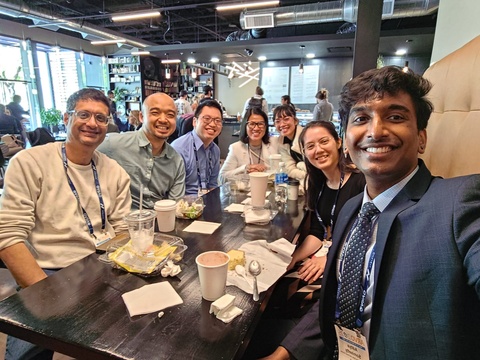
Near the end of the same presentation are photographs of his own students at ARVO—standing beside posters, gathering with colleagues and sharing meals.
Pouw hopes those students leave with something beyond another line on their CV.
“The goal is to try to get them to these conferences so they can have their, ‘this is what I want to do’ validation moment,” he said.
Years ago, Pouw had his.
Now, another generation of Iowa medical students is getting the opportunity to have their own and learning how to create that opportunity for the students who follow.